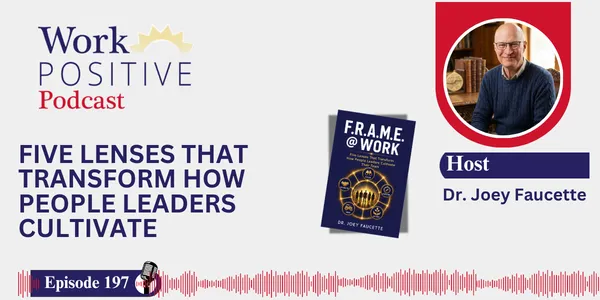
EP 197: Five Lenses That Transform How People Leaders Cultivate | Dr. Joey Faucette
Maya took over operations at her regional logistics company and watched her team's engagement score fall from 68 to 41 in a single quarter. Two of her best people resigned within nine days of each other. Then she walked into the breakroom three minutes early and heard three of her remaining top performers describe her as a micromanager who was out of touch.
She googled how to fix a toxic team. She found tactics, templates, and promises of six-week transformations.
What she discovered instead is the whole of this episode. Her team carried a perception challenge more than a tactics challenge. And the perception that transforms first belongs to the people leader.
Key Insights
Bad events carry roughly four times the psychological weight of good events of equal magnitude, according to Roy Baumeister's research at Florida State University. One piece of negative feedback drowns out about four pieces of positive feedback.
Negativity bias kept your ancestors alive. It costs your team its engagement today.
Gallup's 2025 global engagement research puts the cost of disengagement in the trillions of dollars annually, with the people leader as the variable that explains most of that variance.
F: Focus the Team's Attention. Vultures and hummingbirds fly over the same desert and find two entirely different meals. Your team finds what you train them to look for.
R: Reframe the Unfamiliar. Four horses moved from a 100-foot paddock to a five-acre pasture and used four square feet of it for twenty-one days. Your team escapes the physical prison long before it escapes the mental one.
A: Affirm What's Working. High-performing teams run a positivity ratio near three to one. Affirmation that lands is specific, named, and in the moment.
M: Mow the Mental Broom Straw. Sigal Barsade's research at Wharton demonstrates that emotion transfers through a team below conscious awareness. Your team consumes what you fail to filter.
E: Establish Rituals That Stick. James Clear frames it plainly: you fall to the level of your systems. Practice creates the perception.
Martin Seligman's Three Good Things practice raised happiness and lowered depressive symptoms after one week, with effects measurable six months later.
The lens you cultivate at work follows you home. Maya's teenage son installed Three Good Things at the family dinner table without her ever mentioning it.
Insights Unpacked
Dr. Joey opens with the four-to-one problem. Roy Baumeister's research explains why a single difficult interaction with a colleague gets retold at three dinner tables while four quiet acts of excellence pass unnamed. The brain evolved that weighting for survival. It now works against the very engagement a people leader needs.
The F lens answers it. Maya's coach assigns her one week of leading every meeting with a specific, named, observed contribution. The first morning she stands in front of her team blank, because she spent six months filing competence and generosity as background noise. She reaches for one thing: Roberto stayed forty minutes past his shift to help a struggling colleague close a complicated order. She names Roberto, what he did, and why it mattered. Roberto's expression transforms. So does every other face in the room. Her team did what they always did. What transformed is where Maya looked.
The R lens moves to Daniel Kahneman's two systems. System 1 sorts every new piece of information by asking whether it has seen this before, and it deletes what it fails to recognize. That is the moment a team member says, "I've never done it that way before." Carol Dweck's thirty years of mindset research adds the leadership consequence: as your team encounters the unfamiliar, your face is the first source of data they consult. Maya applies it during a software rollout, tells her team out loud that the discomfort is the brain requesting the familiar, and names day eleven of a twenty-one-day window. The complaints subside that afternoon. By day twenty-three, two of the original resisters teach the newer team members.
The A lens carries the ratio. Losada and Fredrickson found high-performing teams running near three positive interactions for every negative one, while Gottman found successful marriages near five to one. Most people leaders run the inverse and then wonder why the ideas stopped. The team stopped because contributing produced correction more reliably than recognition. Maya's Friday notebook fixes it: three specific contributions, each naming a person, a behavior, and an impact. Five minutes a week. Engagement climbs in month three, with no recognition program, no incentive structure, and no added budget.
The M lens is the broom straw on the farm. It grows where the soil tilts off balance, it competes with the spring grass, and horses pick around it. Left standing, it wins and the pasture stops being a pasture. Negative perception grows the same way in a team's mental environment. Dr. Joey adds the six grains of sand: six a day for thirty days is one hundred and eighty grains in the engine, and six months is over a thousand. Bob Nicoll's convenience store sign carries the practical fix. "Don't Forget the Ice" sold slowly in 110-degree heat. "Remember the Ice" tripled sales in three weeks. You write the signs your team reads every day.
The E lens brings it home. Dr. Joey sits in his farmhouse kitchen before sunrise, eyes closed, and realizes the window is shut. He raises it, and a bird is singing the most beautiful song. The bird was singing the whole time. The closed window was the only thing that transformed. The contributions inside your team are happening right now, ahead of the lens that finds them. What is missing is the ritual that opens the window.
Then the reveal that earns the hour. Sixteen weeks into Maya's Friday practice, on a Tuesday evening in month seven, her teenage son Theo sits down at dinner and says, "Three good things." She asks what he means. He tells her they do this now, and offers to go first. She had said nothing about it at home. Maya cried for ten minutes after Theo went to bed.
Your team is singing right now. The question is whether your window is open.
Do One Thing
Choose one ritual from this episode and commit to it for twenty-one days. The morning three minutes in the car. The Friday three good things. The evening gratitude diary. The Sunday team observations.
One ritual. Twenty-one days. If you miss a day, restart at day one, because the brain rewires through unbroken repetition.
Resources
Get F.R.A.M.E. @ Work: Five Lenses That Transform How People Leaders Cultivate Their Team: workpositive.today/frame-at-work
Read this week's blog, Establish Rituals That Stick
Take the free Work Positive Culture Assessment: workpositive.today
Connect with Dr. Joey on LinkedIn for the free digital copy offer mentioned in the episode
Your Next Best Step
Your culture already does one of these five lenses well. Discover which one, and discover the lens with the most room to transform how your team perceives work. The free Work Positive Culture Assessment gives you both answers in a few minutes at workpositive.today.
Connect with Dr. Joey & Work Positive
Work Positive Podcast: workpositive.today/podcasts
Free Work Positive Newsletter: workpositive.today/newsletter
Enjoying the show?
Leave a rating and a review on Apple Podcasts so more people leaders discover the Work Positive Podcast. It takes a minute and helps the whole community.
Know a leader who would be a great guest? Send your recommendation to [email protected].