Hope is NOT a Strategy
Ever catch yourself thinking, "I sure hope _______ gets better soon"?
How is that hope strategy working out for you?
Dr. Marie-Helene Pelletier, psychologist, business strategist, and author of The Resilience Plan, told me on the Work Positive Podcast one line worth writing down.
"Hope is not a strategy."
You hope your team is resilient. You hope people manage their stress. You hope your culture elevates rather than depletes the people you depend on.
That doesn’t Work Positive.
Resilience is a capacity you deliberately and systematically create.
The T.H.R.I.V.E. framework coaches you as a people leader to develop your team’s resilience.
The I in T.H.R.I.V.E. is for Invest: Implement Your Resilience Plan.
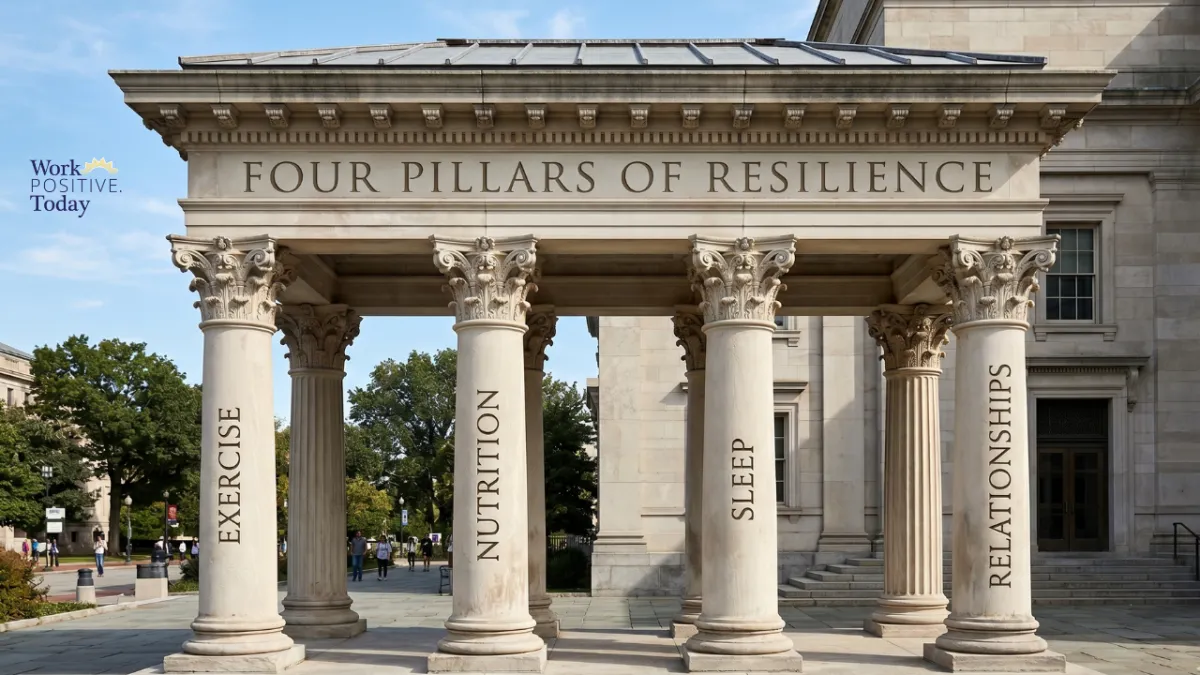
The Four Pillars of Resilience
Dr. M-H identified on her Work Positive Podcast episode four behavioral variables that account for most of what she calls your resilience buffer, your capacity to absorb stress without breaking:
exercise
nutrition
sleep
time in valued relationships.
She told me, "These four things, it's not because they look simple that they are simple to implement."
You already know them. The challenge is consistent implementation, especially in the context of an actual life with competing demands and shifting seasons.
Your Supply, Your Demand
Most people wildly overestimate their energy supply and dramatically underestimate their demands. Dr. M-H sees this in most leaders with whom she works.
Ask a people leader to name their stressors and they list one or two. Press them, and the actual picture emerges. A colleague on leave, so her workload got absorbed. A promotion that arrived with enormous new complexity. A close friend is navigating a divorce. A parent is aging rapidly. A child is struggling at school.
Every one of those is a demand that drains your energy, even the positive ones.
Dr. M-H told me, "Until we have a realistic perspective, we think we're fine."
Her strategic resilience planning begins with your values, which determine which demands are worth accepting and which release. Next comes an honest assessment of your current energy supply. Then you examine every demand without minimizing it. Finally, you assess the actual season of life you are in rather than the one you wish you were in.
That honest picture allows you to create a realistic, doable resilience plan and invest in it.
Go Granular
Dr. M-H identified workload as the single greatest threat to psychological health and safety in most organizations. Her counterintuitive approach is granular.
Rather than asking, "What is too much?" ask, "What specific part of your work creates the most pressure?"
Granular-seeking questions surface relevant data:
What is the specific process step that costs you the most energy?
What is the task that would take thirty minutes with a better checklist and currently takes two hours because no one created the checklist?
What is the thing you do rarely that stresses you out because it is unfamiliar?
Dr. M-H told me, "We know from research this is where the gold is."
One specific process, identified and improved, releases significant pressure for the individual. The act of asking signals your team that you see them, their working conditions matter to you, and you are willing to act.
Resilience Belongs on the Agenda
Dr. M-H shared one more practice with the Work Positive Community. Put resilience on the meeting agenda. Fifteen minutes. Once a month. Every month.
"Having even the word 'resilience' on our agenda on a regular basis changes the culture," she told me.
Priorities get protected.
Your Invest Do One Thing (DOT) Challenge
Sit with your team this week and ask each person to identify one granular pressure point.
Fix that one thing.
Make resilience a standing fifteen-minute agenda item.
Work Positive Bottom Line
Hope is not a strategy. Invest in resilience. Do One Thing that increases resilience today.
This post is from Dr. Joey Faucette's newest best-seller, T.H.R.I.V.E. @ Work: Mental Health, Culture, and the People You Lead.
Keywords: resilience plan, mental health, work culture, leadership strategy, THRIVE framework, stress management, workload, psychological safety #WorkPositive #CultureEatsStrategyForBreakfast #THRIVEatWork #ResiliencePlan #MentalHealthAtWork